
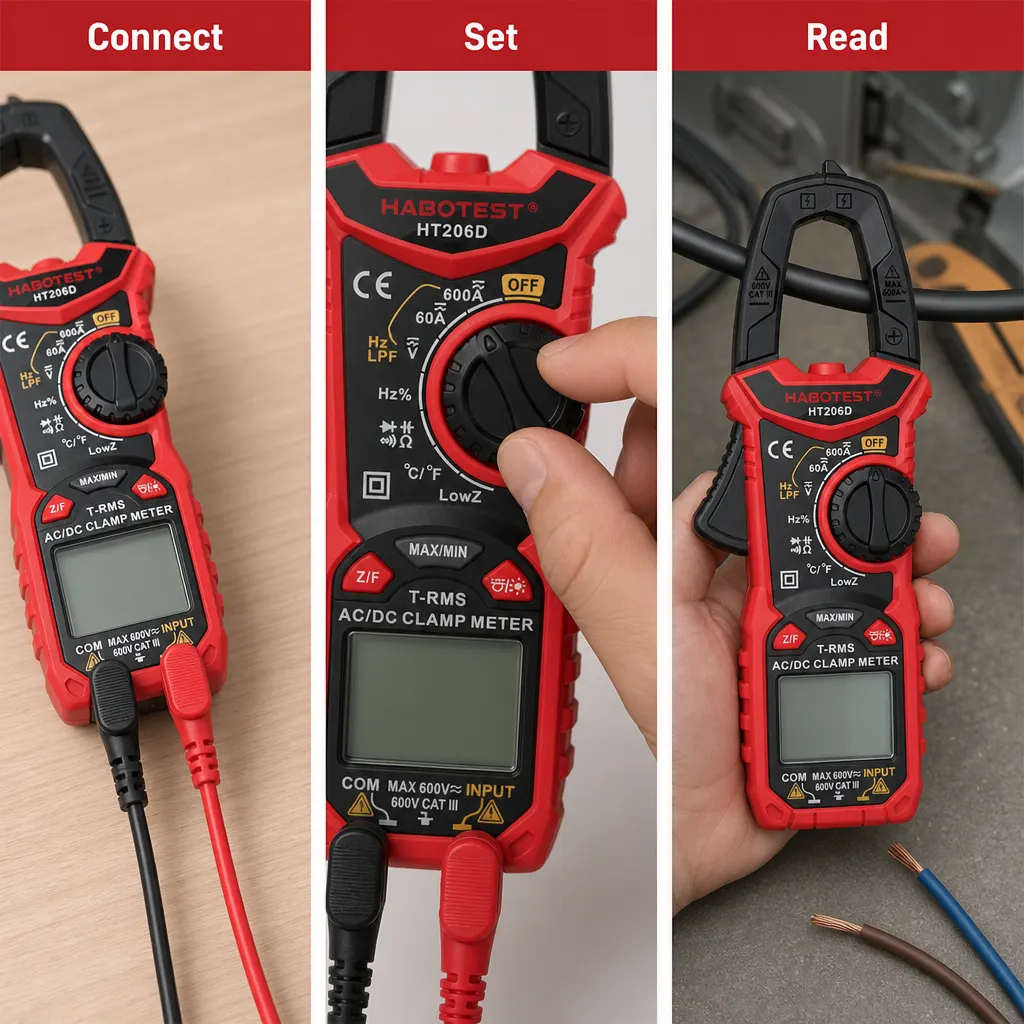
Short answer: For DC current work on van circuits, the first question is whether the clamp meter is explicitly described for DC rather than only AC. The HABOTEST HT206D page identifies AC/DC current checking with 60 A and 600 A markings, True RMS wording and CAT III 600 V on the instrument. It is an English-language unit supplied without a battery. Those facts may support an initial shortlist, but the page does not establish a van-specific procedure, accuracy, jaw opening, lead rating or compatibility with every vehicle system. Match the meter to the job sheet and vehicle documentation before relying on it.
Screen the van job against the meter
A van may contain starting, charging, auxiliary, inverter or body electrical circuits with different working conditions. The product page gives a broad AC/DC clamp-meter description and 60 A and 600 A markings, but it does not identify a particular vehicle, circuit family or diagnostic workflow. Use those facts as an initial filter only.
The important comparison is between the expected current and the method required by the vehicle or workshop documentation. If the task needs a narrow tolerance, a specified response or a known conductor capacity, the manufacturer does not specify those fields on the current page.
| Van-work question | Current listing | Do not assume |
|---|---|---|
| Current type | AC/DC wording | Every vehicle circuit is covered |
| Range | 60 A and 600 A markings | Accuracy or resolution at the reading |
| Safety label | CAT III 600 V wording shown | Independent certification or vehicle approval |
| Ready to use | No battery supplied | Battery type or runtime |
Plan access and isolation at the van
The clamp format is helpful only if the relevant individual conductor can be accessed without creating a new hazard or invalidating the vehicle procedure. Bundled conductors, limited clearance and live work around moving or hot components can all change the practical method. The product page does not publish a jaw dimension or van-specific instructions.
HSE says electrical work should be planned, energy sources isolated securely where relevant and carried out by competent people. A current reading is not a substitute for the vehicle manufacturer's procedure or a controlled workshop method.
- Identify the exact van circuit and expected current before selecting a range.
- Read the vehicle or workshop procedure for isolation and access requirements.
- Confirm the conductor can be reached individually and the clamp can close correctly.
- Check the instrument marking and required records against the task.
- Do not proceed when the method or competence boundary is unclear.
Verify the English HT206D and its contents
The order should identify the HABOTEST HT206D English AC/DC clamp meter. The page states that no battery is supplied and the image shows an English manual, test leads, a temperature probe and a zippered case. Confirm the actual box contents if any item is needed for the van job.
A van technician should also separate visible feature wording from missing technical evidence. True RMS, CAT III 600 V, accuracy, lead specification, calibration and jaw capacity are not all equivalent claims. The manufacturer does not publish the missing fields on the current product page.
Limits and checks before buying
The HT206D can remain on the shortlist for a van job that needs a documented AC/DC clamp format within the marked ranges and is already covered by a competent procedure. It should not be sold to yourself as a guaranteed vehicle diagnostic solution.
Obtain the vehicle-specific method, the full meter manual and any required technical evidence before purchase. If the work depends on a stated tolerance, conductor size, battery type or calibration record, the public listing alone is insufficient.
Related guides and product details
For van circuits, treat the HT206D as a possible measurement format, then verify the vehicle procedure and all missing meter specifications before relying on it. Read True RMS Clamp Meter CAT III: Read the Labels Carefully for related guidance. Read How to Choose a 600A AC/DC Clamp Meter for Workshop Checks for related guidance. Review the documented specification on the HABOTEST HT206D AC/DC Clamp Meter (English, No Battery) product page before ordering.
Sources and safety context
- Supports the model identity, AC/DC wording, marked ranges, True RMS and CAT III 600 V wording, English version and no-battery supply. Current Testermodel HT206D product page.
- Supports planned work, secure isolation and competence requirements. Work on electrical equipment, machinery or installations.