
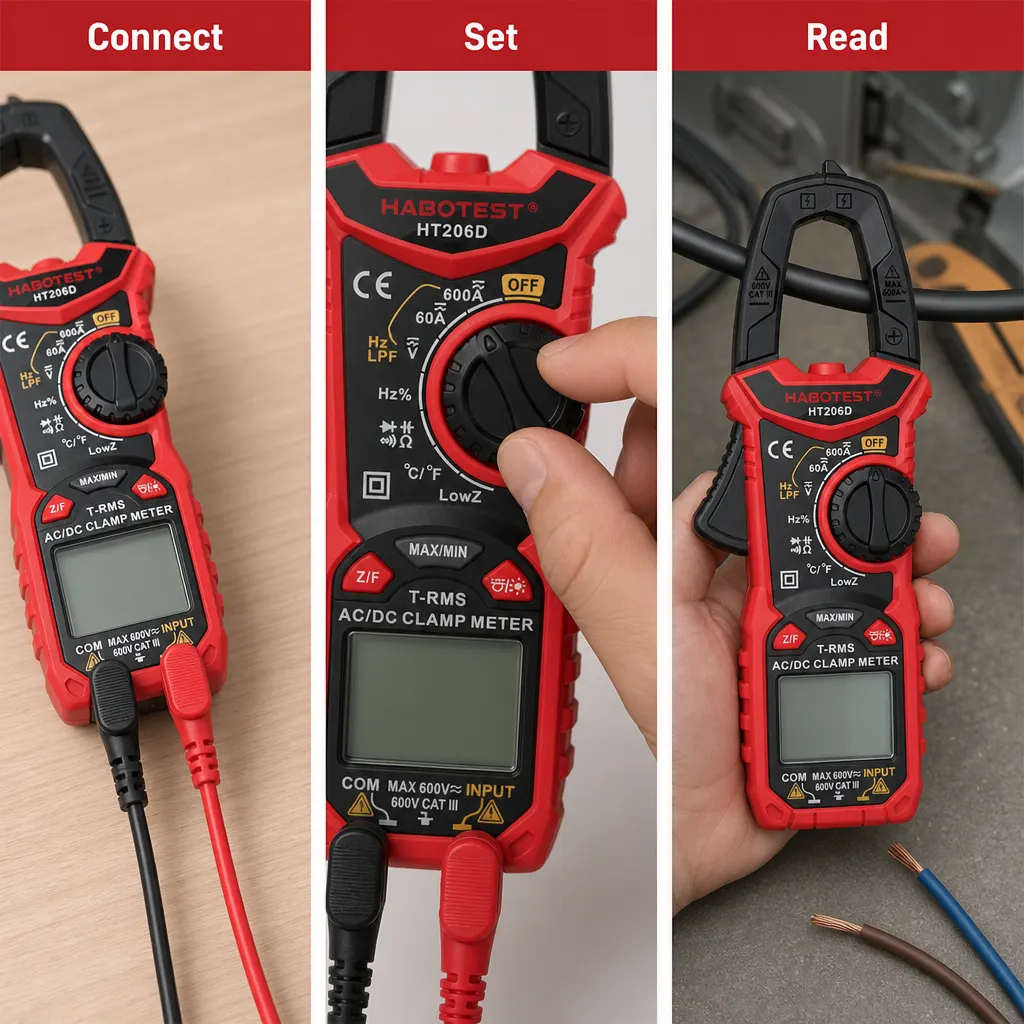
Short answer: A 600A AC/DC clamp meter should be chosen around the circuit and working method, not the largest number in the product title. The HABOTEST HT206D page identifies AC and DC current ranges marked 60 A and 600 A, True RMS wording and CAT III 600 V on the instrument. That makes it a candidate for a workshop that needs both current types, but it does not establish accuracy, resolution, jaw capacity or calibration status. Write down the expected current, circuit type, conductor access and workplace requirements first. Then compare those needs with the documented product facts and ask for any missing specification before ordering.
Match the marked range to the workshop job
The 600 A label is useful only after the expected circuit current is understood. The product page presents 60 A and 600 A AC/DC ranges, so a buyer can use those markings as an initial screening point for a planned check. They do not say what current is normally present, and they do not promise accuracy at a particular point within either range.
A job expected to exceed 600 A is outside the marked range described on the page. A low-current job may need a specified resolution or tolerance that the listing does not provide. The manufacturer does not specify those details, so do not fill the gap with a typical value from another meter.
| Workshop question | What the page documents | What still needs checking |
|---|---|---|
| Current type | AC and DC current wording | The exact circuit and method for the job |
| Marked ranges | 60 A and 600 A | Accuracy and resolution at the expected current |
| Upper limit | 600 A marking | A different instrument if the job is above that range |
| Physical fit | Clamp-meter format | Jaw opening and conductor capacity |
Check the conductor and working environment
A clamp reading depends on reaching the relevant individual conductor in a way that suits the procedure. A tightly packed cable, a bundled positive and return path, or a conductor that cannot be accessed may make the format unsuitable even when the current range looks right. The product page does not publish jaw opening or conductor-size capacity.
HSE says electrical work should be planned, energy sources isolated securely where relevant and carried out by people with suitable competence. A clamp meter does not make live work safe, and a CAT III 600 V marking shown on the instrument is not the same as a complete site-specific risk assessment or independent certification claim.
- Identify whether the planned check concerns AC, DC or both.
- Estimate the expected current and compare it with the marked 60 A and 600 A ranges.
- Confirm that the individual conductor can be accessed without relying on an unverified jaw dimension.
- Check the working environment, equipment category requirement and competence boundary.
- Stop and obtain the missing documentation if the job needs defined accuracy, calibration or traceability.
Verify the exact HT206D variant and kit
The product page identifies an English HABOTEST HT206D and says that no battery is supplied. The image shows an English manual, test leads, a temperature probe and a zippered case. Those details are useful for matching the basket to the intended item, but an image should not be treated as a contractual packing list without confirmation.
Keep the brand, model and language variant together when comparing listings. The manufacturer does not specify the battery type on the current page. If the meter must be ready for a scheduled job, confirm the battery requirement and actual box contents before planning around them.
Limits and checks before buying
The HT206D is a reasonable candidate when the documented AC/DC wording and marked ranges match a defined workshop check. It is not enough evidence for a purchase that depends on a stated tolerance, traceable calibration, known jaw size, specified low-current resolution or a complete powered kit.
Choose only after the product page, manual or seller confirmation answers the fields that matter to the job. Do not infer road, plant or installation safety from the current marking alone, and do not use the meter as permission for work outside your training or the site's procedure.
Related guides and product details
For a workshop comparison, buy the HT206D only when its documented AC/DC ranges and physical format fit the written job sheet and the missing technical fields are not decisive. Read 600A Clamp Meter for Electricians: What to Check for related guidance. Read AC/DC Clamp Meter UK: A Practical Buying Guide for related guidance. Review the documented specification on the HABOTEST HT206D AC/DC Clamp Meter (English, No Battery) product page before ordering.
Sources and safety context
- Supports the model identity, AC/DC wording, marked ranges, True RMS and CAT III 600 V wording, English variant and no-battery statement. Current Testermodel HT206D product page.
- Supports planning, secure isolation, suitable equipment and competence boundaries. Work on electrical equipment, machinery or installations.