
Short answer: A clamp meter for DC battery current is useful only when the meter explicitly covers DC, the expected current fits the marked range and the circuit exposes the right conductor. The HABOTEST HT206D page describes AC/DC operation with 60 A and 600 A markings and identifies an English version supplied without a battery. That is a useful starting point for a UK workshop comparison, but it does not prove suitability for every battery, vehicle or pack. Check the circuit design, working procedure and required evidence first. Treat accuracy, jaw capacity, battery type and calibration as unspecified unless confirmed in writing.
Confirm that the current really is DC
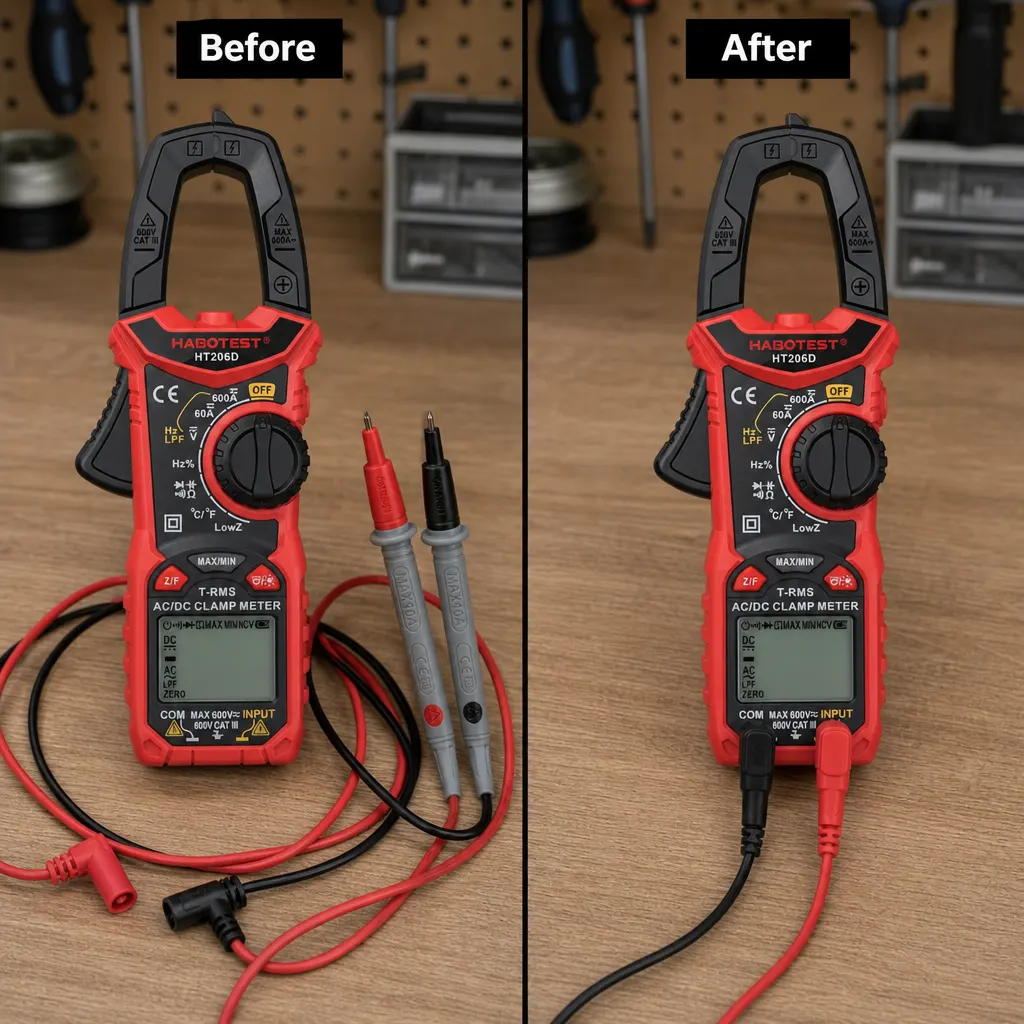
The first filter is the current type. The HT206D listing describes AC/DC current checking and shows 60 A and 600 A markings, so it is at least presented for a task where DC matters. That does not tell you whether a particular battery system, charger, inverter or vehicle circuit falls within the instrument's full operating specification.
Write down the expected current and the point at which it will be observed. If the job requires a defined resolution, accuracy or response behaviour, the manufacturer does not specify those fields on the current product page. Do not use a generic battery chart as a substitute for the instrument manual.
| Battery-current question | Documented starting point | Unspecified field |
|---|---|---|
| AC or DC? | AC/DC wording | The exact battery system and circuit behaviour |
| Expected load | 60 A and 600 A markings | Accuracy and resolution at the load |
| Physical access | Clamp-meter format | Jaw opening and conductor capacity |
| Power for the meter | No battery supplied | Battery type and runtime |
Check the conductor before the battery
A clamp measurement normally needs the relevant individual conductor to pass through the jaws. If outgoing and return conductors are enclosed together, their magnetic effects can change what the clamp sees, so the planned access and procedure matter. The product page does not provide a jaw dimension or a vehicle-specific method.
HSE guidance requires electrical work to be planned, energy sources isolated securely where relevant and undertaken by competent people. A battery system can still contain significant energy. Do not open, move or probe a pack simply because a clamp meter is available.
- Identify the battery, circuit and intended current observation point.
- Check the owner's procedure and isolate energy sources where the work requires it.
- Confirm that one conductor can be reached without assuming a jaw size.
- Compare the expected current with the marked 60 A and 600 A ranges.
- Stop if the method, access or competence requirement is not established.
Keep the model and preparation facts together
For a UK bench or mobile job, retain the exact identity: HABOTEST HT206D, English version, supplied without a battery. The product image shows an English manual, test leads, a temperature probe and a zippered case, but the current page does not turn the image into a guaranteed packing list.
The manufacturer does not specify supported battery chemistry, maximum system voltage, accuracy, jaw capacity or calibration status on the public page. Those omissions are important if the reading will inform a repair decision or a formal record.
Limits and checks before buying
The HT206D may be suitable for a defined DC current check when the marked ranges, conductor access and working procedure align. It should not be treated as a universal battery diagnostic tool, a proof of battery health or permission to work on an unfamiliar high-energy system.
Ask for the full manual and written product specification if the battery chemistry, voltage, accuracy, jaw size or calibration record matters. If the answer remains unknown, choose a meter with explicit documentation for the task.
Related guides and product details
For DC battery current work, buy around the conductor and the safe procedure first; the HT206D is only a candidate until its missing specifications are resolved. Read DC Current Clamp for Van Circuits: Check the Meter First for related guidance. Read True RMS Clamp Meter CAT III: Read the Labels Carefully for related guidance. Review the documented specification on the HABOTEST HT206D AC/DC Clamp Meter (English, No Battery) product page before ordering.
Sources and safety context
- Supports AC/DC wording, marked ranges, model identity, English variant and no-battery supply. Current Testermodel HT206D product page.
- Supports planning, secure isolation and competence boundaries for electrical work. Work on electrical equipment, machinery or installations.