
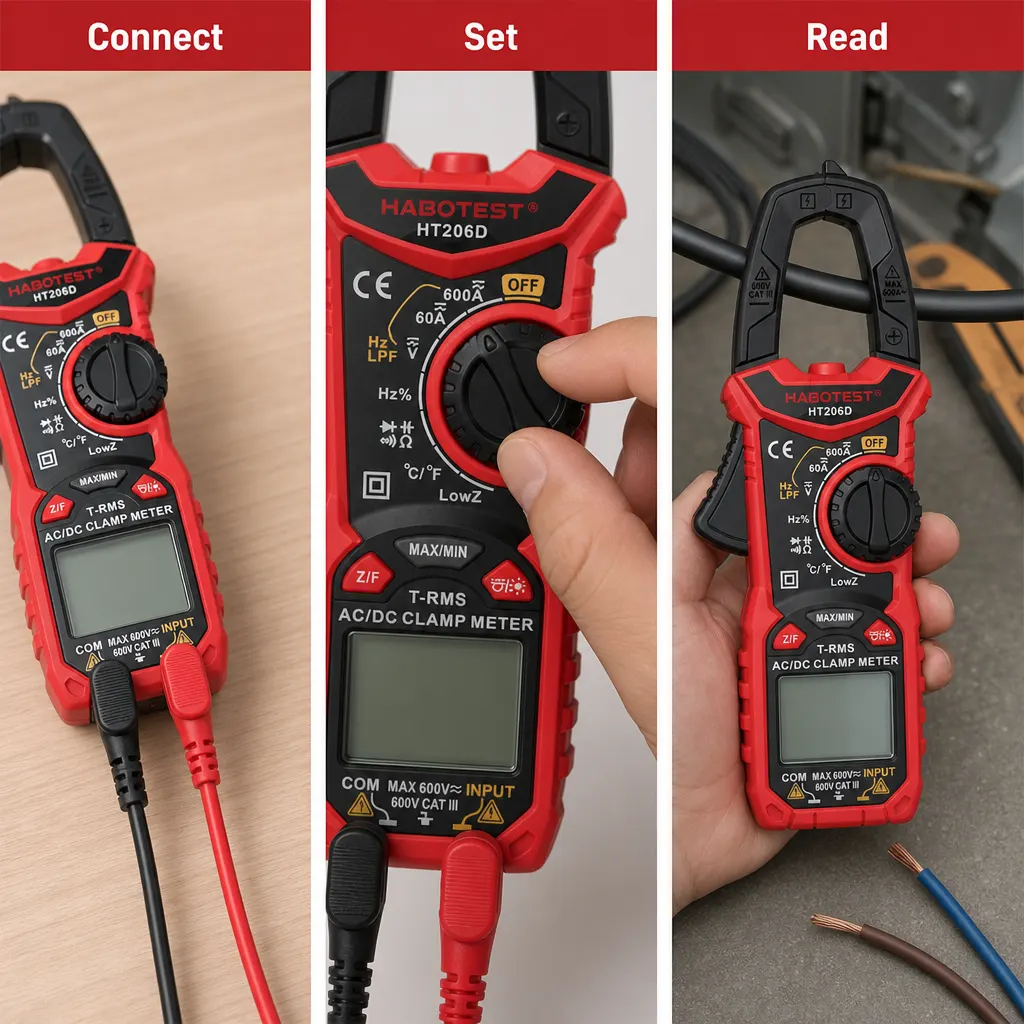
Short answer: A True RMS clamp meter with CAT III wording should be assessed by separating feature labels from the evidence needed for a real electrical task. The HABOTEST HT206D page shows True RMS operation, CAT III 600 V wording and AC/DC current markings at 60 A and 600 A. It does not publish accuracy, frequency response, lead category, jaw opening, calibration status or an independent certificate on the current product page. Read the labels as documented product information, then compare the full job, environment and required records with the manual and the applicable safe-working procedure.
What True RMS and CAT III mean in this listing
The current product page uses True RMS wording and shows CAT III 600 V on the instrument. For a buyer, these are relevant comparison fields because they describe how the product is presented. They are not a replacement for the exact manual, a test certificate or a site-specific assessment.
The same page gives AC/DC current wording and 60 A and 600 A markings. It does not state accuracy, resolution, frequency range, transient performance, lead category or calibration status. The manufacturer does not specify those fields in the public product description.
| Label or field | What the page says | What it does not prove |
|---|---|---|
| True RMS | True RMS wording is shown | A stated accuracy or frequency response |
| CAT III 600 V | The marking is shown on the instrument | Independent certification or suitability for every installation |
| Current | AC/DC, 60 A and 600 A markings | Resolution, tolerance or range behaviour |
| Power | No battery supplied | Battery type or operating runtime |
Connect the labels to the real work
A category marking cannot choose the conductor, test point or working method for you. Check the circuit, environment, access and the evidence required by the job. The clamp format may be unsuitable where the conductor is bundled or the jaws cannot close, and the product page does not publish those dimensions.
HSE guidance says electrical work should be planned, energy sources isolated securely where relevant and carried out by competent people. Treat the meter as one item in that procedure, not as a shortcut around it.
- Define the circuit, current type and expected current.
- Confirm the work environment and the category evidence required there.
- Check conductor access and lead condition before relying on the clamp format.
- Ask for accuracy, resolution, frequency and calibration information if the result is recorded.
- Use the current manual and competent-person procedure for the actual measurement.
Keep the HT206D identity and unknowns visible
The page identifies an English HABOTEST HT206D and says that no battery is supplied. It shows an English manual, test leads, a temperature probe and a zippered case in the product image. Keep those facts separate from the technical fields that are absent.
The manufacturer does not specify jaw opening, conductor capacity, battery type, accuracy, calibration status or a complete independent safety dossier on the current page. Those unknowns may be harmless for a simple comparison, but they are material when the reading will support a formal decision.
Limits and checks before buying
A True RMS and CAT III-marked clamp meter can be worth considering when the documented AC/DC ranges fit the task and the user has the required competence. The labels alone do not guarantee accuracy, compatibility, road safety, installation safety or performance in a particular circuit.
Ask for the missing evidence before purchase if the job depends on it. Otherwise select the HT206D only as a bounded match to the published facts, with the no-battery supply and unspecified fields recorded in the decision.
Related guides and product details
Use the HT206D labels to start a shortlist, then make the decision from the full working method and the technical evidence the job actually requires. Read How to Choose a 600A AC/DC Clamp Meter for Workshop Checks for related guidance. Read 600A Clamp Meter for Electricians: What to Check for related guidance. Review the documented specification on the HABOTEST HT206D AC/DC Clamp Meter (English, No Battery) product page before ordering.
Sources and safety context
- Supports the visible True RMS, CAT III 600 V, AC/DC, 60 A and 600 A wording, model identity and no-battery supply. Current Testermodel HT206D product page.
- Supports planning, secure isolation and competence boundaries. Work on electrical equipment, machinery or installations.