
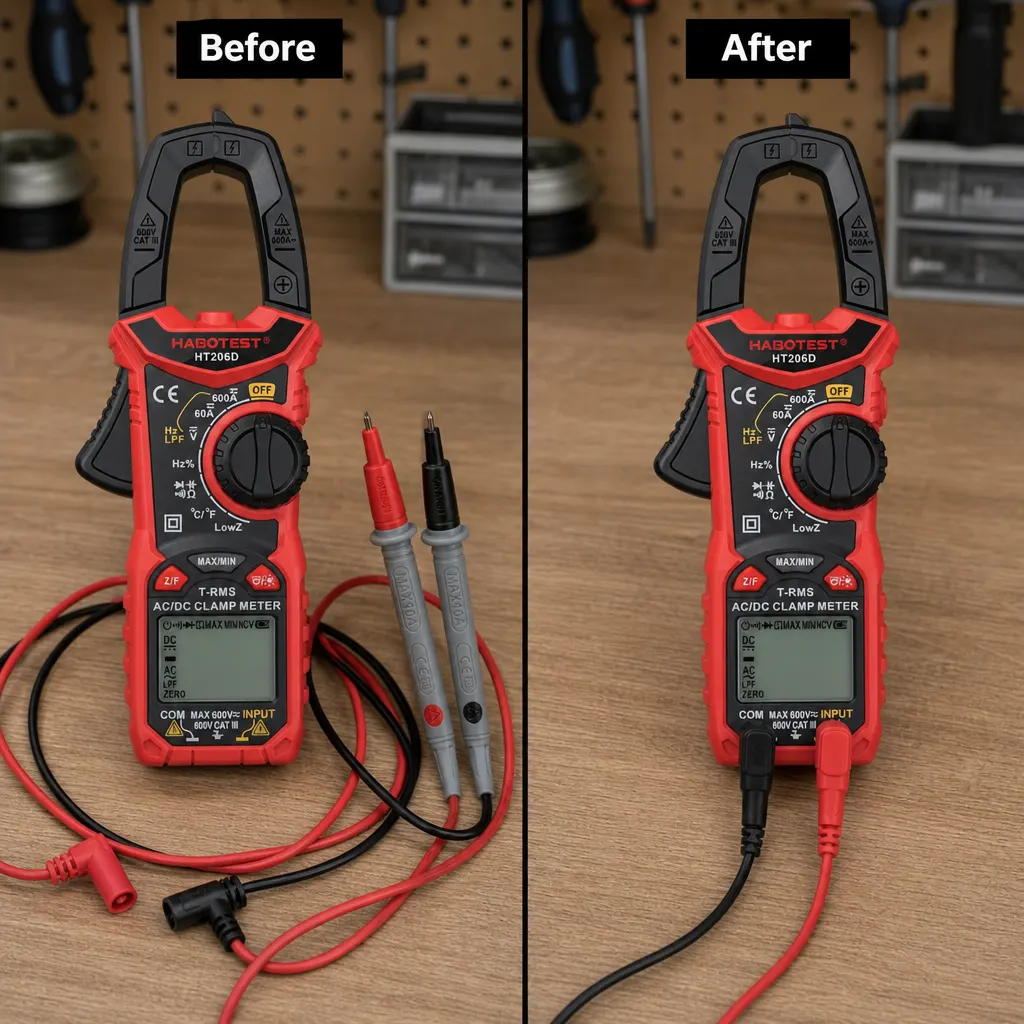
Short answer: An electrician comparing a 600A clamp meter needs more than a high current number. The HABOTEST HT206D product page describes AC/DC current checking with 60 A and 600 A markings, True RMS wording and CAT III 600 V on the instrument. It is supplied as an English-language unit without a battery. Those facts can help screen a purchase, but they do not confirm accuracy, jaw opening, lead category, calibration or compatibility with every installation. Define the task, access and required documentation first, then treat any unspecified field as a question for the manufacturer or seller.
Start with the electrician's actual task
A clamp meter can be a useful format when the job calls for current observation without putting the meter directly in series, but the circuit and the method still govern the choice. The HT206D page explicitly describes AC/DC current coverage and shows 60 A and 600 A markings. That makes the model relevant to a mixed-workshop shortlist, not automatically suitable for every installation.
Before ordering, record whether the work is diagnostic, commissioning, maintenance or a documented test. Note the expected current, conductor arrangement, access, environment and the evidence your employer or client requires. The current product page does not publish enough technical detail to answer all of those questions.
| Selection field | HT206D page | Electrician still needs to verify |
|---|---|---|
| Current | AC/DC, 60 A and 600 A markings | Expected current and required accuracy |
| Safety marking | CAT III 600 V wording shown | Applicable site category and supporting documentation |
| Power | No battery supplied | Battery type and job-readiness |
| Access | Clamp-meter format | Jaw opening and conductor clearance |
Use a safe pre-job sequence
The instrument should sit inside the work method, not define it. HSE guidance says work should be planned, energy sources isolated securely where relevant and carried out by competent people. If the task is outside the user's competence or the site's procedure, the product's category wording does not change that boundary.
The following sequence is a purchase and preparation check, not permission to work on live equipment. Follow the current manual, employer method statement and applicable electrical rules for the actual installation.
- Write down the circuit type, expected current and measurement objective.
- Confirm the relevant conductor can be reached individually and safely.
- Check the required equipment category, lead condition and workplace records.
- Match the job with the marked range and ask for missing accuracy or jaw data.
- Arrange the unspecified battery and confirm the delivered model before attendance.
Read CAT and True RMS without overclaiming
The product page shows True RMS operation and CAT III 600 V wording on the housing. These labels are useful comparison points, but the page does not publish a full independent test certificate, measurement accuracy, frequency response, calibration status or lead specification. The manufacturer does not specify those fields in the current listing.
A buyer who needs a recorded electrical result should ask for the exact manual and supporting documents before relying on the meter. Do not turn a visible mark into a promise that the instrument is suitable for every transient, panel or non-linear-load scenario.
Limits and checks before buying
The English HT206D may fit an electrician who needs a compact AC/DC clamp format for checks within the marked ranges and already has a suitable working procedure. It is a poor basis for a purchase that depends on a known jaw size, a specified tolerance, traceable calibration or a battery being included.
Confirm the exact model, language variant, contents, battery requirement and documentation before checkout. If the missing fields affect safety or the recorded result, choose a better-documented alternative rather than making a hopeful inference from the product name.
Related guides and product details
Treat the HT206D as a candidate for a defined electrician's task, then verify the missing specifications and the complete safe-working procedure before buying. Read AC/DC Clamp Meter UK: A Practical Buying Guide for related guidance. Read Clamp Meter for DC Battery Current UK: What to Check for related guidance. Review the documented specification on the HABOTEST HT206D AC/DC Clamp Meter (English, No Battery) product page before ordering.
Sources and safety context
- Supports the listed model, AC/DC ranges, True RMS and CAT III 600 V wording, English version and no-battery supply. Current Testermodel HT206D product page.
- Supports planned work, secure energy isolation and competence boundaries. Work on electrical equipment, machinery or installations.