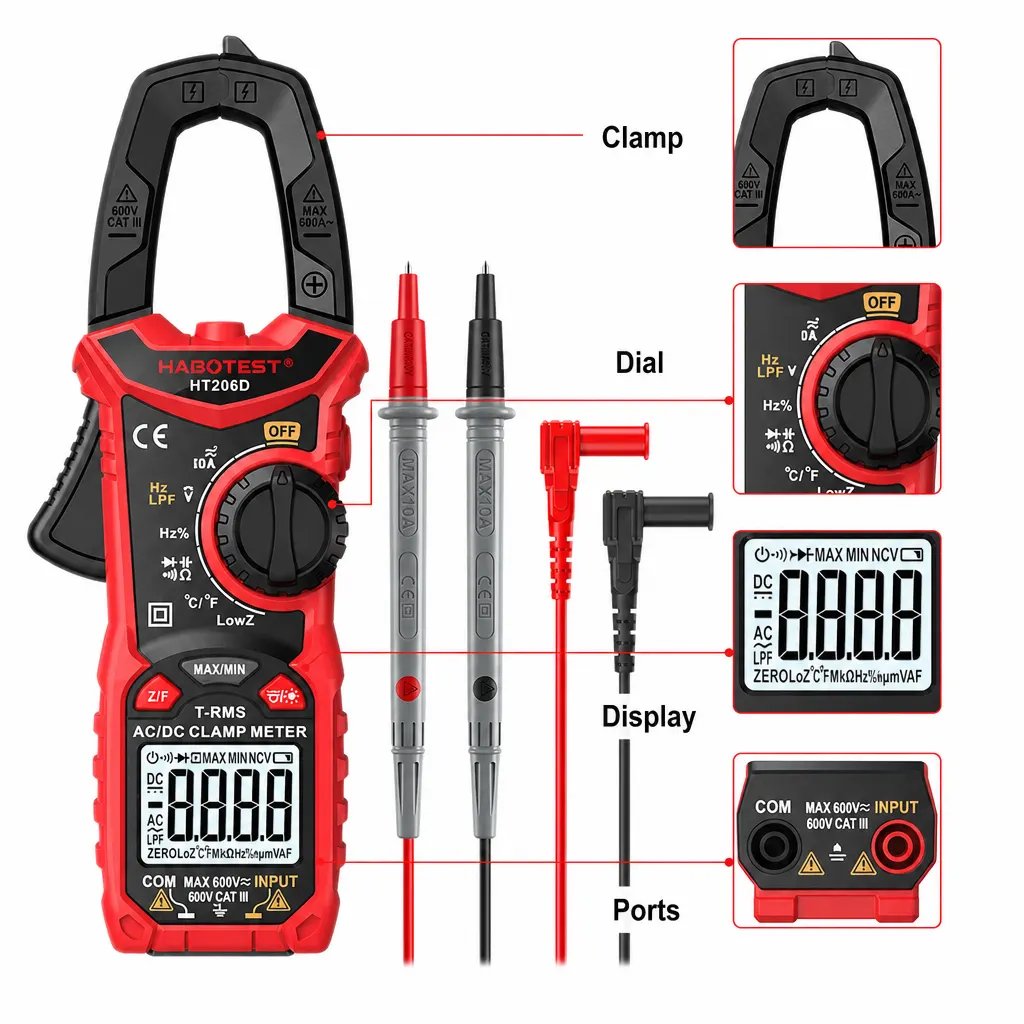
Choose the current type before you compare meters

If your work includes both alternating-current and direct-current circuits, start with an AC DC clamp meter rather than an AC-only model. The HABOTEST HT206D listing is identified as an English-interface AC/DC clamp meter, with visible markings for 60 A and 600 A current ranges. That makes the first practical check straightforward: confirm that the product description says AC/DC and that the model shown is HT206D. You can then decide whether its documented range matches the current you expect to measure, without opening the circuit simply to place a meter in series.
This is particularly relevant when one UK job moves between a mains panel, a van, a battery system or another mixed electrical setting. A clamp meter is chosen because it can be placed around a conductor for a current reading, but the circuit type still matters. An AC-only clamp meter does not answer a DC-current requirement. Conversely, seeing AC/DC on a listing does not establish every possible function, accuracy level or specialist capability, so the purchase decision should stay tied to the job and to facts that are actually documented.
Match the meter to the UK workshop or service setting
For an electrician or maintenance technician moving between a workshop bench and a customer call-out, the useful question is not simply whether a meter looks compact. Ask what you are likely to measure at the point of work. A household or plant-room task may involve AC, while vehicle and battery-related checks are commonly considered in DC terms. The locked HT206D description identifies AC/DC current ranges of 60 A and 600 A on the instrument, so those markings are relevant starting points when you compare the expected circuit current with the stated range.
A clamp meter can also reduce the need to disconnect a conductor for a current measurement, which may make a planned check more convenient. It does not remove the need for a suitable working method, competent handling or compliance with the requirements of the job. The product information does not provide a full method statement, nor does it establish that every installation or environment is suitable. Treat the meter as a measurement instrument to be checked against the task, not as a substitute for electrical planning, isolation procedures or professional judgement.
Check the documented markings without extending the claims
The housing image for the HABOTEST HT206D shows the words True RMS and a CAT III 600 V marking, alongside 600 A and 600 V figures. True RMS language can be relevant when you are investigating readings from non-linear loads, inverters or drives and an average-responding meter may not give the result you expect. It is still only one part of the comparison. The available facts do not state accuracy, bandwidth, calibration status or detailed VFD performance, so none of those should be assumed from the True RMS label alone.
The same caution applies to the CAT marking. The public product information says that CAT III 600 V is visible on the housing; it does not provide independent certification evidence or a complete safety specification. Keep the wording precise when you assess a listing: a visible housing marking is a documented product detail, not proof of every safety or compliance question you may need answered. If a job has a specified measurement category, calibration requirement, accuracy tolerance or specialist power-quality need, obtain the relevant evidence before relying on this instrument.
Use this comparison sequence at the packing bench
A short check before ordering can prevent the most common mismatches. First, write down the circuit types you expect to encounter: AC, DC or both. Next, note the highest current and voltage your planned measurement could involve. Then compare those requirements with the markings documented for the HT206D: AC/DC current, 60 A and 600 A ranges, and 600 V shown on the housing. After that, decide whether True RMS is relevant to the readings you are trying to understand, while keeping separate any requirement for accuracy, calibration, bandwidth or power-quality analysis.
At the packing bench, use this sequence as a practical checklist. Confirm that the title identifies HABOTEST HT206D, not HT206A or HT206B. Confirm that the interface is English rather than the excluded Russian-language HT206D listing. Confirm that the offer clearly says no battery. Check that the product image and written listing refer to the same model. Finally, record any requirement the public facts do not answer, such as accuracy or calibration, and resolve that point before purchase rather than filling the gap with assumptions.
Verify the English HT206D SKU before checkout
Model confusion is a genuine issue when similar HT206-series listings appear beside one another. The locked offer is the HABOTEST HT206D English-interface version. HT206A, HT206B and the Russian-language HT206D rows are excluded from this offer. That distinction matters if you need English controls or documentation at a UK workshop, and it is worth checking the written title as well as the product image. Do not rely solely on a familiar-looking photograph when different model letters or language variants may be displayed in search results.
The listing states that the product is supplied without a battery. Plan for that before a call-out or bench session: check the battery requirement in the supplied instructions or product information and arrange a suitable battery separately if needed. The public image also shows an English user manual, test leads, a temperature probe and a zippered case, but an image should not automatically be treated as a complete contractual inventory. If a particular accessory is essential, confirm its inclusion in the offer before ordering. The no-battery status, however, is explicit and should be treated as part of the buying decision.
Know when this clamp meter is the wrong fit
The HT206D may be a poor match if your work depends on a documented accuracy figure, traceable calibration, a specified frequency bandwidth or a confirmed specialist function that is not stated in the available facts. It should not be selected merely because the housing says True RMS if the real requirement is detailed power-quality analysis or a particular VFD diagnostic specification. Those jobs need their own instrument criteria and evidence. Similarly, if your work calls for a different measurement method, such as insulation testing or a specialised analyser, a general AC/DC clamp meter will not automatically cover it.
It may also be the wrong choice if the no-battery arrangement is inconvenient for an urgent visit and you cannot prepare the required power source. A missing battery is not necessarily a defect here; it is a disclosed supply condition. The important point is to avoid arriving at a warehouse panel, vehicle or workshop bench expecting immediate operation without checking what is needed. Buyers who require a particular language, model variant, accessory or compliance document should treat that requirement as a condition to verify, not as something inferred from a generic marketplace title.
Separate the useful facts from marketplace noise
When comparing listings, give priority to details that identify the actual offer: HABOTEST as the brand, HT206D as the model, English interface, AC/DC wording and no-battery supply. The public description specifically excludes HT206A, HT206B and Russian-language HT206D rows. It also avoids relying on third-party marketplace brand names. This is useful when several listings use similar photographs or inconsistent naming. A seller’s product title, visible housing and written supply condition should agree before you proceed.
Be cautious with copied tables that add claims not present in the documented product facts. For this offer, the available public information does not establish a detailed accuracy specification, calibration certificate, bandwidth, review consensus or independent certification. It also does not justify promising that every pictured item is guaranteed beyond the stated description. A careful buyer can still make a well-informed initial choice by identifying what is known, listing what remains unanswered and deciding whether those unanswered points matter for the intended UK job.
Take the next step with a job-specific check
Before opening the checkout page, write a one-line requirement for the job: for example, “I need to check AC and DC current on a workshop, vehicle or battery-related circuit without disconnecting the conductor.” Compare that line with the documented HT206D facts. The listing identifies an English HABOTEST HT206D, shows AC/DC current markings with 60 A and 600 A ranges, displays True RMS and CAT III 600 V on the housing, and states that no battery is supplied. Those points answer the basic fit question without pretending to answer technical questions that are not documented.
Then make a final go-or-stop decision based on the gaps that matter to you. If you need a stated accuracy, calibration evidence, bandwidth or specialist analyser function, seek that information first. If the basic requirement is an English AC/DC clamp meter and the no-battery condition is acceptable, check the model and language again at checkout and prepare the required battery before the meter reaches the packing bench. That simple process helps an ac dc clamp meter uk search lead to a correctly identified purchase rather than an avoidable variant or accessory mismatch.